Posts

Showing posts with the label Egg

Improving Hatchability of Parrot Eggs in Incubators: Tips and Tricks

Breeding parrots is a delicate process, and raising healthy offspring from parrot eggs can be quite challenging. For many breeders, incubating parrot eggs is a common practice. However, the hatchability of parrot eggs can be influenced by many factors, such as temperature, humidity, turning frequency, and ventilation. In this article, we will discuss some tips and tricks that can help improve the hatchability of parrot eggs in incubators. 1. Start with Healthy Parrot Eggs The first step in ensuring a successful hatch is to start with healthy parrot eggs. This means selecting eggs that are not cracked, discolored, or deformed. It is also essential to ensure that the eggs are not contaminated with bacteria or other harmful microorganisms. 2. Proper Storage Before incubation, parrot eggs should be stored in a cool, dry place. The ideal temperature for storage is between 55 and 65 degrees Fahrenheit, with a humidity level of 75 to 80 percent. Eggs should be turned several times a day to pr...

Incubation Period and Clutch Size for Parrot Species

Following is a table of various parrot species, their scientific names, clutch size and incubation period. This is meant to be a guide for breeders. The incubation day count begins from the day proper incubation is started by the birds or in the incubator and not from the day the egg was laid. Always check eggs via candling before discarding. Species Scientific Name Clutch Size Incubation Period Adelaide Rosella  Platycercus adelaidae 4 - 7 eggs 21 days African Grey Parrots Psittacus erithacus erithacus 3 - 4 eggs  28 days Alexandrine Parakeet  Psittacula Eupatria 2 - 4 Eggs 28 Days Amboina King Parakeets  Alisterus amboinensis 3 eggs  21 days Antipodes Green Parrot or Antipodes Island Parakeet  Cyanoramphus unicolor 2 - 6 eggs  26 days Bare-eyed Cockatoo or Little Corella  Cacatua sanguinea: normantomi, sanguinea) 2 - 3 eggs ...

Record Keeping for Bird Keepers

Image
Bird keeping can be more rewarding with record keeping. Record keeping for bird keepers is maintaining information about each bird, each pair, each clutch & each egg. Furthermore it's about recording your actions related to bird set up, diet, medication etc and the results they produce. Getting Started A few things that you need to get started The first thing you need is the ability to uniquely identify each bird. You must be able to identify every bird listed in your records. If you have only a few birds and their physical appearance makes it straight forward to identify them then you need not worry about this. However, if you have dozens of birds that closely resemble each other you may need a way to positively identify each bird. This process is made easy through the use of leg bands or microchips. A leg band assigns a unique number to a bird which can be used to identify that bird. Microchips may also be embedded in larger species which can be read by an electroni...

Getting Started with Breeding Ringnecks

Image
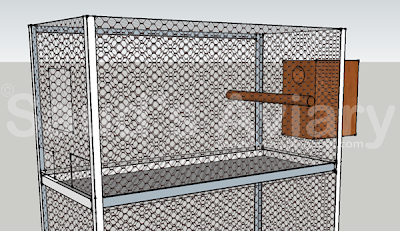
First of all you need to pick the right cage. Ringnecks require a minimum cage size of 24in x 24in x 48in. The front of the cage should be 24x24 with feeding stations. The depth should be 48inches with the nest box installed outside at the back of the cage. There should be a perch about 1.5-2in in diameter 6-8in from the back wall and just below the opening to the nest box. The logic behind such a setup is that the nest box should be farthest from human approach during feeding times. Birds feels secure in such an environment and are more likely to breed. The illustration below shows this setup. The mesh used for the cage should be rectangular weld mesh and not expanded metal mesh as shown in the picture. The nest box should be filled with white pine shavings 3in deep. The cage should be protected from direct wind and prolonged exposure to sun. While sunlight is great for birds, a shaded area in the cage should always be available to them. Once you have the setup in place, you ...

Pair #3 Clutch Updates May, 2012

Image
Pair #3 has hatched 3 chicks. This is their first successful clutch after the first two clutches produced 3 infertile eggs and 2 dead in shell. I will post the videos and images of the pair and chicks here as they progress. Chicks are now 1 week old ... and here they are at 2 months and 24 days of age. They have started nibbling corn and veggies,  eating soaked chick peas  and also playing with seeds. I am still hand feeding them twice a day.