Posts

Showing posts with the label Parrot

Getting Started with Breeding Ringnecks
Image
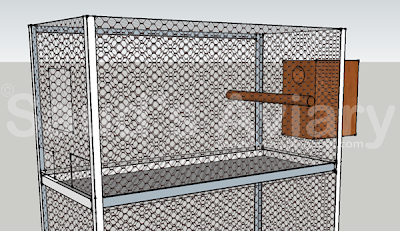
First of all you need to pick the right cage. Ringnecks require a minimum cage size of 24in x 24in x 48in. The front of the cage should be 24x24 with feeding stations. The depth should be 48inches with the nest box installed outside at the back of the cage. There should be a perch about 1.5-2in in diameter 6-8in from the back wall and just below the opening to the nest box. The logic behind such a setup is that the nest box should be farthest from human approach during feeding times. Birds feels secure in such an environment and are more likely to breed. The illustration below shows this setup. The mesh used for the cage should be rectangular weld mesh and not expanded metal mesh as shown in the picture. The nest box should be filled with white pine shavings 3in deep. The cage should be protected from direct wind and prolonged exposure to sun. While sunlight is great for birds, a shaded area in the cage should always be available to them. Once you have the setup in place, you ...

Pair #3 Clutch Updates May, 2012

Image
Pair #3 has hatched 3 chicks. This is their first successful clutch after the first two clutches produced 3 infertile eggs and 2 dead in shell. I will post the videos and images of the pair and chicks here as they progress. Chicks are now 1 week old ... and here they are at 2 months and 24 days of age. They have started nibbling corn and veggies,  eating soaked chick peas  and also playing with seeds. I am still hand feeding them twice a day.

Alexandrine Mutations Project: Year 2 (2012)

Image
This post relates to my Alexandrine Mutations Project. If you are new to my blog you should start reading about this project here . To summarize, I paired up a normal Alexandrine cock to an albino ringneck hen last year to start my alexandrine mutations project. The hen laid 10 eggs in two clutches but all eggs were infertile. Here's what happened this year.   The pair was moved to a breeding cage in preparation for the 2012 season in September 2011. The birds were still bonded, perching together and the male feeding the hen. They however showed no interest in the nest box. As the breeding season peaked, the hen started to flirt with me again. She would jump to the cage floor and approach the feeding area where I would be refreshing their food and water dishes. She would then assume a mating position and make a cooing sound. I would ignore her and carry on with my tasks. The male would sit on the perch and watch the hen very closely. He was not very happy at the sit...

Alexandrine Mutations Project: Year 1 (2011)

Image
I have written a few articles on breeding Alexandrine mutations including the Lutino  and Blue mutations. These articles were based on internet research and my own knowledge of genetics. I practically started working on this project in Aug 2010 by paring a normal Alexandrine male to an Albino Indian ring-neck hen. This allows me to get started on both the blue and lutino mutations simultaneously. All chicks from this pairing will be useful in the next generation. The males will be useful for the lutino project and the females for the blue Alexandrine project. The hen was bred in Jan 2009 from a blue ringneck pair where the cock was split to ino. She was hand raised from 3 weeks old and was a tame bird when weaned. I wanted to keep her as a breeder and stopped handling her soon after weaning. She still does not fear humans like other birds and always comes close to me during feeding time. The male was purchased in July 2010 as a young adult approximately two yea...

Gender Bias in Lutino x Pallid IRN Pairing

Image
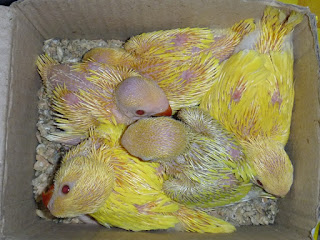
I have a pair of Indian Ringneck Parrots.  The male is lutino and the hen is pallid. The genetics of this pairing dictate that the male chicks will be pallidino and females will be lutino. It is therefore possible to identify the sex of the chicks in the box soon after hatching. The pallidino males have dark, blood red eyes, whereas the lutino hens eyes are a lighter red. As the birds start to grow pin feathers, the difference in the sexes becomes even more obvious. The lutinos show pure yellow pins and the pallidinos have a greenish tinge on their feathers. The photo shows 4 lutino female chicks and a pallidino male from the latest clutch. This pair has produced 18 chicks in 4 clutches during the last 2 years. The expected male to female ratio is 50:50. However, this pair has produced only 5 males and 13 females. The last two clutches have been 5 chicks each, with only 1 male and 4 females. The observation is based on the result of several clutches and seems to be stati...

Hand Rearing African Grey Chicks

Image
This blog will detail hand rearing of two African grey chicks. You may read about their parents and the clutch  here . The two chicks hatched on Jan 6 and Jan 9, 2012. They were pulled on Jan 22 with one aged 13 days and the other 16 days. The chicks were close banded on Jan 22. The band id of the chicks are SAUD-202 and SAUD-203 respectively. Here is their first photo and their data. SAUD-202 (L) SAUD-203 (R) 13 and 19 days Old ID: SAUD-202 Hatch Date: Jan 6, 2012 Pulled on: Jan 22, 2012 (16 days) Weight: 129g ID: SAUD-203 Hatch Date: Jan 9, 2012 Pulled on: Jan 22, 2012 (13 days) Weight: 117g The chicks are housed inside a homemade brooder made out of an old fish tank. The bottom is covered with wood shavings and lined on top with tissue paper. The brooder temperature is maintained at 90'F. The chicks hatched 3 days apart but their size does not differ significantly. The older chick had its eyes open at the time of pulling w...

Pair #5 Jan 2012 Clutch Updates

Image
Pair #5 This is a Red-Factor pair. The female has several red feathers on her chest and legs and the male has a splash of red feathers on its back. They have laid their first egg today on Jan 19, 2012 . I am very eager to see if their chicks will show any red feathers. However, I am not getting my hopes up as the males is a young bird. Possibly only 4 years old. It is not very likely that the eggs are fertile. I will know for sure in about 2 weeks.  Jan 21, 2012 There are now two eggs. The hen has started incubation. The pair spends the night inside the box. The nest box does not have provision for a camera. It is a new box that I purchased a few months back but go lazy about providing a hole for a camera. This means physical nest box inspections throughout the incubation period. Jan 24, 2012 Still two eggs. I think this will be the clutch size. The eggs are not showing fertile yet. I will check them again in a few days. Jan 29.2012 Both eggs are sti...

Pair #4 Dec 2011 Clutch Updates

Image
Dec 21, 2011 There are a total of 2 eggs. laid on the 8th and 12th Dec. I have not checked the box since the 12th.  There is provision for camera installation in the box but it is not installed. It will only take a minute to do it but I don't want to upset the pair as they are not accustomed to it. The birds  may see it as a foreign object sitting on their heads and might abandon the eggs for a few hours or completely. In this cold weather, if the eggs are chilled it would be lethal for the embryo. Once (and IF) the chicks hatch out, I will install the camera to ensure they are being taken care of properly. I usually install the camera when I am expecting the pair to lay. I thought Pair 2 was closer to laying but Pair 4 beat them to it.  When I checked the box on the 12th I also candled the eggs. I think the first egg was showing a vein and might be fertile or may be it was just wishful thinking. I will check the box again on Sunday and candle the eggs if they let me. ...

Repairing a Dented African Grey Egg

Image
This was my first attempt at repairing an egg.  I used white glue and a kids paint brush. Gently applied a coat on the dented area, allowed it to dry for 15-20 minutes before applying the next coat. A total 3 coats were applied.  I took some pictures of the egg before and after the repair. The third picture shows the egg being candled after repair.   There were only two eggs in this clutch. The repaired egg turned out to be fertile while the other was infertile. The egg developed normally but mysteriously disappeared around the hatch date. Although I did not get a chick from this egg the normal development showed that the repair was successful. 

African Grey Pair #3 Incubation videos

Image
Here are a couple of videos of Pair #3 from their last clutch. The cock feeding the hen in the nest box. The hen incubating

Breeding Alexandrine Mutations: The Lutino

Introduction The Alexandrine is a beautiful bird similar in appearance to the Indian Ringneck. The characteristics that distinguish an alexandrine from an Indian Ringneck include red-brown shoulder patches, a wider neck ring and larger size. While the Indian Ringneck is available in several color mutations the Alexandrine is generally available only in the normal green. It is possible to produce Alexandrine  colour  mutations by hybridizing the Alexandrine with the Indian Ringneck. Such a program however requires a long term commitment, space and responsible breeding practices to be successful and to preserve the purity of both species. In this article a breeding program is outlined that breeds a sex-linked mutation such as Lutino into the Alexandrines. To start the breeding program you need a good normal Alexandrine and a Lutino Ringneck. There are two options at the start of the program. 1) A Lutino Ringneck cock paired to a normal Alexandrine hen 2) Normal Alex...