Posts

Showing posts with the label Lutino

G1 Pairs, Visiting the Box

Image
The G1 males are now nearing 21 months of age. Both have been paired to adult normal Alexandrine hens for the last few months.  Pairs have nicely bonded. Hens are visiting the box but no eggs yet. Males are very vocal and excited. Here are some fresh pics taken on 15/12/2013. Pair1 Pair 2 Male 1 Male 1 Male 1 Male 2 Male 2

G1 Males after moult at 1 year 5 months

Image
The G1 males have almost completed their annual moult. The wing patches have improved a lot and are now clearly visible though they are still a little broken in appearance and not as bright as a pure Alexandrine. Neck rings are also clearly visible and look very similar to the Alexandrine neck ring rather than that of a ringneck. The length of the bird is also very good approaching that of a pure normal alexandrine. Both males are split to ino and split to blue. I have noticed that their tails have a bluish tinge on the primary tail feather when viewed from behind. My pure alexandrines show primary tail feathers that are yellow and not blue. Is the blue tinge in the tail due to the split blue in the birds? I am not sure but it would be interesting and also useful to explore this possibility. I will be pairing these males to pure Alex hens soon. Half the chicks from this pairing will be split blue. The tail color might offer a clue to which chicks are split blue. Obviously, the pr...

Alexandrine Mutations Project: G1 Chicks 1+ year Old

Image
This post relates to my Alexandrine Mutations Project. If you are new to my blog you should start reading about this project  here . The G1 chicks are now almost 13 months old. The head and body size is distinctly bigger than that of a ringneck. The shoulder patches are still quite faint. The birds have not undergone the annual moult yet. Perhaps the patches may improve after the moult is completed. An important question was whether the birds would mature in 2 years like ringnecks or 3 like the alexandrines. During the season, I observed a female chick crouching in the mating position and a male displaying to her. This suggestes that the birds may be ready for breeding next season. Here are a few fresh pic of the birds.

Alexandrine Mutations Project: Year 2 (2012)

Image
This post relates to my Alexandrine Mutations Project. If you are new to my blog you should start reading about this project here . To summarize, I paired up a normal Alexandrine cock to an albino ringneck hen last year to start my alexandrine mutations project. The hen laid 10 eggs in two clutches but all eggs were infertile. Here's what happened this year.   The pair was moved to a breeding cage in preparation for the 2012 season in September 2011. The birds were still bonded, perching together and the male feeding the hen. They however showed no interest in the nest box. As the breeding season peaked, the hen started to flirt with me again. She would jump to the cage floor and approach the feeding area where I would be refreshing their food and water dishes. She would then assume a mating position and make a cooing sound. I would ignore her and carry on with my tasks. The male would sit on the perch and watch the hen very closely. He was not very happy at the sit...

Alexandrine Mutations Project: Year 1 (2011)

Image
I have written a few articles on breeding Alexandrine mutations including the Lutino  and Blue mutations. These articles were based on internet research and my own knowledge of genetics. I practically started working on this project in Aug 2010 by paring a normal Alexandrine male to an Albino Indian ring-neck hen. This allows me to get started on both the blue and lutino mutations simultaneously. All chicks from this pairing will be useful in the next generation. The males will be useful for the lutino project and the females for the blue Alexandrine project. The hen was bred in Jan 2009 from a blue ringneck pair where the cock was split to ino. She was hand raised from 3 weeks old and was a tame bird when weaned. I wanted to keep her as a breeder and stopped handling her soon after weaning. She still does not fear humans like other birds and always comes close to me during feeding time. The male was purchased in July 2010 as a young adult approximately two yea...

Gender Bias in Lutino x Pallid IRN Pairing

Image
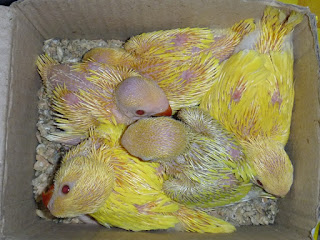
I have a pair of Indian Ringneck Parrots.  The male is lutino and the hen is pallid. The genetics of this pairing dictate that the male chicks will be pallidino and females will be lutino. It is therefore possible to identify the sex of the chicks in the box soon after hatching. The pallidino males have dark, blood red eyes, whereas the lutino hens eyes are a lighter red. As the birds start to grow pin feathers, the difference in the sexes becomes even more obvious. The lutinos show pure yellow pins and the pallidinos have a greenish tinge on their feathers. The photo shows 4 lutino female chicks and a pallidino male from the latest clutch. This pair has produced 18 chicks in 4 clutches during the last 2 years. The expected male to female ratio is 50:50. However, this pair has produced only 5 males and 13 females. The last two clutches have been 5 chicks each, with only 1 male and 4 females. The observation is based on the result of several clutches and seems to be stati...

Breeding Alexandrine Mutations: The Lutino

Introduction The Alexandrine is a beautiful bird similar in appearance to the Indian Ringneck. The characteristics that distinguish an alexandrine from an Indian Ringneck include red-brown shoulder patches, a wider neck ring and larger size. While the Indian Ringneck is available in several color mutations the Alexandrine is generally available only in the normal green. It is possible to produce Alexandrine  colour  mutations by hybridizing the Alexandrine with the Indian Ringneck. Such a program however requires a long term commitment, space and responsible breeding practices to be successful and to preserve the purity of both species. In this article a breeding program is outlined that breeds a sex-linked mutation such as Lutino into the Alexandrines. To start the breeding program you need a good normal Alexandrine and a Lutino Ringneck. There are two options at the start of the program. 1) A Lutino Ringneck cock paired to a normal Alexandrine hen 2) Normal Alex...