Posts

Breeding Well-Marked Pieds

Image
Nov 03, 2012 One of my breeding objectives this year was to breed some well marked pieds. I have an own bred hen who was one of the first chicks I bred from a pied pair I obtained from Lahore in 2009. She is very well marked and has previously been bred with split pieds and not so well marked birds. She is a good experienced breeder but has not produced any chick with a pattern as good as her own. The cock The hen The male I chose for her this year is a bird I purchased from the Liaquatabad market in July 2011. He was young at the time of purchase. He has an almost equally good pattern as the hen. Last year he bred well with an experienced hen who is the mother of the hen mentioned above. These two birds were paired up on 17/09/2012. Since both birds were experienced good breeders, I was expecting them to get down to business within 2 weeks. They showed some initial signs of bonding but then the male lost interest. Pairs around them started to lay but they seemed un...
Getting Started with Breeding Ringnecks

Image
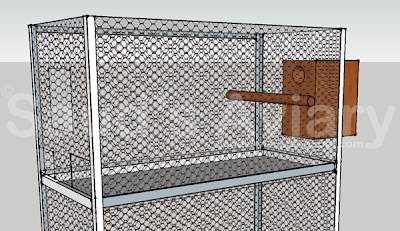
First of all you need to pick the right cage. Ringnecks require a minimum cage size of 24in x 24in x 48in. The front of the cage should be 24x24 with feeding stations. The depth should be 48inches with the nest box installed outside at the back of the cage. There should be a perch about 1.5-2in in diameter 6-8in from the back wall and just below the opening to the nest box. The logic behind such a setup is that the nest box should be farthest from human approach during feeding times. Birds feels secure in such an environment and are more likely to breed. The illustration below shows this setup. The mesh used for the cage should be rectangular weld mesh and not expanded metal mesh as shown in the picture. The nest box should be filled with white pine shavings 3in deep. The cage should be protected from direct wind and prolonged exposure to sun. While sunlight is great for birds, a shaded area in the cage should always be available to them. Once you have the setup in place, you ...

Maximix: Supplementary food for birds

Image
Aves Maximix is a supplementary food for birds. This product contains all essential vitamins, minerals and trace elements. Specific particulars of AVES-MAXIMIX are Contains 50 vitamins, minerals, trace-elelements and amino-acids which can be deficient under practical conditions The protein contains all essential amino-acids, plus extra amino-acids to compensate for specific amino-acid deficiences encountered in many diets Especially suitable for birds which cannot tolerate normal dosages of iron (hemochromatosis) Contains extra vitamin E, C, biotin, calcium, arginine and lysine Supply Aves Maximix under the following conditions: 1) When condition and egg production are sub-optimal 2) When a complete and balanced food supplement is required Packing 600g, 200g To place an order for delivery anywhere in Pakistan please Contact Me by email

Change in feathering of Red-Factor Greys

Image
The following relates to my CAG pair #5. Both birds in this pair had red some feathering. An interesting development has been the change in appearance of the two birds. The male  had a splash of red feathers on its back (Pic 1). These red feathers have disappeared after the molt  The hen had some red feathers running up the legs and lower abdomen along the wings. This red feathering has increased considerably in the hen. The photo on the left was taken about 15 months ago. The one on the right is current. A couple of my other red factor birds have also lost their red feathering. The question is whether there is a genetic component to this red feathering or not? When this pair breeds successfully, it may help answer this question. So far they have produced 4 infertile clutches. The male in this pair is a young bird. Pic 1: Male showing a splash of red feathers on the back. Pic Taken July 2011, Male Left, Female Right Pic Taken Oct 2012, Female Left, Mal...

Pair #3 Clutch Updates May, 2012

Image
Pair #3 has hatched 3 chicks. This is their first successful clutch after the first two clutches produced 3 infertile eggs and 2 dead in shell. I will post the videos and images of the pair and chicks here as they progress. Chicks are now 1 week old ... and here they are at 2 months and 24 days of age. They have started nibbling corn and veggies,  eating soaked chick peas  and also playing with seeds. I am still hand feeding them twice a day.

Alexandrine Mutations Project: G1 Chicks

Image
This post relates to my Alexandrine Mutations Project. If you are new to my blog you should start reading about this project  here . Father: Normal Alexandrine Mother: Albino Indian Ringneck G1 Chicks: Hatched 3,4 & 8th April 2012 12, 11 and 7 days old 23, 22 and 18 days old Banded SAUD-121, SAUD-122 and SAUD-123 30 days old 34 days Old Not showing any sign of shoulder patch yet 43, 42 and 38 days old A very faint shoulder patch can be seen on close examination June 7, 2012: The DNA results are in. I have two males and one female. Exactly what I was hoping for. July 27, 2012 Chicks are now 16 weeks old. They are showing good size and are significantly larger than pure Ringnecks. The shoulder patches however remain faint and can only be seen on close inspection. The three chicks and their father at the bottom. The father is going through a moult. Compare the size of the chicks to that of the father. The three chicks, t...

Alexandrine Mutations Project: Year 2 (2012)

Image
This post relates to my Alexandrine Mutations Project. If you are new to my blog you should start reading about this project here . To summarize, I paired up a normal Alexandrine cock to an albino ringneck hen last year to start my alexandrine mutations project. The hen laid 10 eggs in two clutches but all eggs were infertile. Here's what happened this year.   The pair was moved to a breeding cage in preparation for the 2012 season in September 2011. The birds were still bonded, perching together and the male feeding the hen. They however showed no interest in the nest box. As the breeding season peaked, the hen started to flirt with me again. She would jump to the cage floor and approach the feeding area where I would be refreshing their food and water dishes. She would then assume a mating position and make a cooing sound. I would ignore her and carry on with my tasks. The male would sit on the perch and watch the hen very closely. He was not very happy at the sit...