Posts

Pair #3 Clutch Updates May, 2012

Image
Pair #3 has hatched 3 chicks. This is their first successful clutch after the first two clutches produced 3 infertile eggs and 2 dead in shell. I will post the videos and images of the pair and chicks here as they progress. Chicks are now 1 week old ... and here they are at 2 months and 24 days of age. They have started nibbling corn and veggies,  eating soaked chick peas  and also playing with seeds. I am still hand feeding them twice a day.

Alexandrine Mutations Project: G1 Chicks

Image
This post relates to my Alexandrine Mutations Project. If you are new to my blog you should start reading about this project  here . Father: Normal Alexandrine Mother: Albino Indian Ringneck G1 Chicks: Hatched 3,4 & 8th April 2012 12, 11 and 7 days old 23, 22 and 18 days old Banded SAUD-121, SAUD-122 and SAUD-123 30 days old 34 days Old Not showing any sign of shoulder patch yet 43, 42 and 38 days old A very faint shoulder patch can be seen on close examination June 7, 2012: The DNA results are in. I have two males and one female. Exactly what I was hoping for. July 27, 2012 Chicks are now 16 weeks old. They are showing good size and are significantly larger than pure Ringnecks. The shoulder patches however remain faint and can only be seen on close inspection. The three chicks and their father at the bottom. The father is going through a moult. Compare the size of the chicks to that of the father. The three chicks, t...

Alexandrine Mutations Project: Year 2 (2012)

Image
This post relates to my Alexandrine Mutations Project. If you are new to my blog you should start reading about this project here . To summarize, I paired up a normal Alexandrine cock to an albino ringneck hen last year to start my alexandrine mutations project. The hen laid 10 eggs in two clutches but all eggs were infertile. Here's what happened this year.   The pair was moved to a breeding cage in preparation for the 2012 season in September 2011. The birds were still bonded, perching together and the male feeding the hen. They however showed no interest in the nest box. As the breeding season peaked, the hen started to flirt with me again. She would jump to the cage floor and approach the feeding area where I would be refreshing their food and water dishes. She would then assume a mating position and make a cooing sound. I would ignore her and carry on with my tasks. The male would sit on the perch and watch the hen very closely. He was not very happy at the sit...

Alexandrine Mutations Project: Year 1 (2011)

Image
I have written a few articles on breeding Alexandrine mutations including the Lutino  and Blue mutations. These articles were based on internet research and my own knowledge of genetics. I practically started working on this project in Aug 2010 by paring a normal Alexandrine male to an Albino Indian ring-neck hen. This allows me to get started on both the blue and lutino mutations simultaneously. All chicks from this pairing will be useful in the next generation. The males will be useful for the lutino project and the females for the blue Alexandrine project. The hen was bred in Jan 2009 from a blue ringneck pair where the cock was split to ino. She was hand raised from 3 weeks old and was a tame bird when weaned. I wanted to keep her as a breeder and stopped handling her soon after weaning. She still does not fear humans like other birds and always comes close to me during feeding time. The male was purchased in July 2010 as a young adult approximately two yea...

Inbreeding: Why & Why not?

Inbreeding is the breeding together of closely related birds. Pairing of siblings, parents to offspring, grand-parents to grand children, half-brothers to half sisters are all examples of inbreeding. Beginners in breeding, often ask why this practice should be avoided when expert breeders regularly use inbreeding to establish new mutations and desirable traits in their lines. This post will discuss why inbreeding should generally be avoided and why it becomes useful for expert breeders. You don't need to be an expert in genetics to understand this article. I will only make use of the concept of dominant and recessive traits to explain the pros and cons of inbreeding. A recessive trait (feature) is one that will not appear in the children unless it is carried by both the parents. Both parents must pass on the same recessive gene to the child for it to become visible. To learn more, please read  Dominant and Recessive Genes  in my Genetics Tutorial . Most undesirable f...

Gender Bias in Lutino x Pallid IRN Pairing

Image
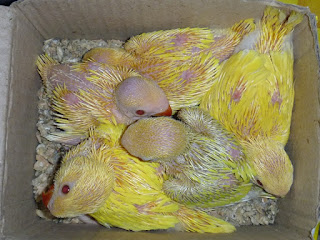
I have a pair of Indian Ringneck Parrots.  The male is lutino and the hen is pallid. The genetics of this pairing dictate that the male chicks will be pallidino and females will be lutino. It is therefore possible to identify the sex of the chicks in the box soon after hatching. The pallidino males have dark, blood red eyes, whereas the lutino hens eyes are a lighter red. As the birds start to grow pin feathers, the difference in the sexes becomes even more obvious. The lutinos show pure yellow pins and the pallidinos have a greenish tinge on their feathers. The photo shows 4 lutino female chicks and a pallidino male from the latest clutch. This pair has produced 18 chicks in 4 clutches during the last 2 years. The expected male to female ratio is 50:50. However, this pair has produced only 5 males and 13 females. The last two clutches have been 5 chicks each, with only 1 male and 4 females. The observation is based on the result of several clutches and seems to be stati...

Hand Rearing African Grey Chicks

Image
This blog will detail hand rearing of two African grey chicks. You may read about their parents and the clutch  here . The two chicks hatched on Jan 6 and Jan 9, 2012. They were pulled on Jan 22 with one aged 13 days and the other 16 days. The chicks were close banded on Jan 22. The band id of the chicks are SAUD-202 and SAUD-203 respectively. Here is their first photo and their data. SAUD-202 (L) SAUD-203 (R) 13 and 19 days Old ID: SAUD-202 Hatch Date: Jan 6, 2012 Pulled on: Jan 22, 2012 (16 days) Weight: 129g ID: SAUD-203 Hatch Date: Jan 9, 2012 Pulled on: Jan 22, 2012 (13 days) Weight: 117g The chicks are housed inside a homemade brooder made out of an old fish tank. The bottom is covered with wood shavings and lined on top with tissue paper. The brooder temperature is maintained at 90'F. The chicks hatched 3 days apart but their size does not differ significantly. The older chick had its eyes open at the time of pulling w...